Tribal Nations Take the Lead on Stewarding Ancestral Waters on the California Coast
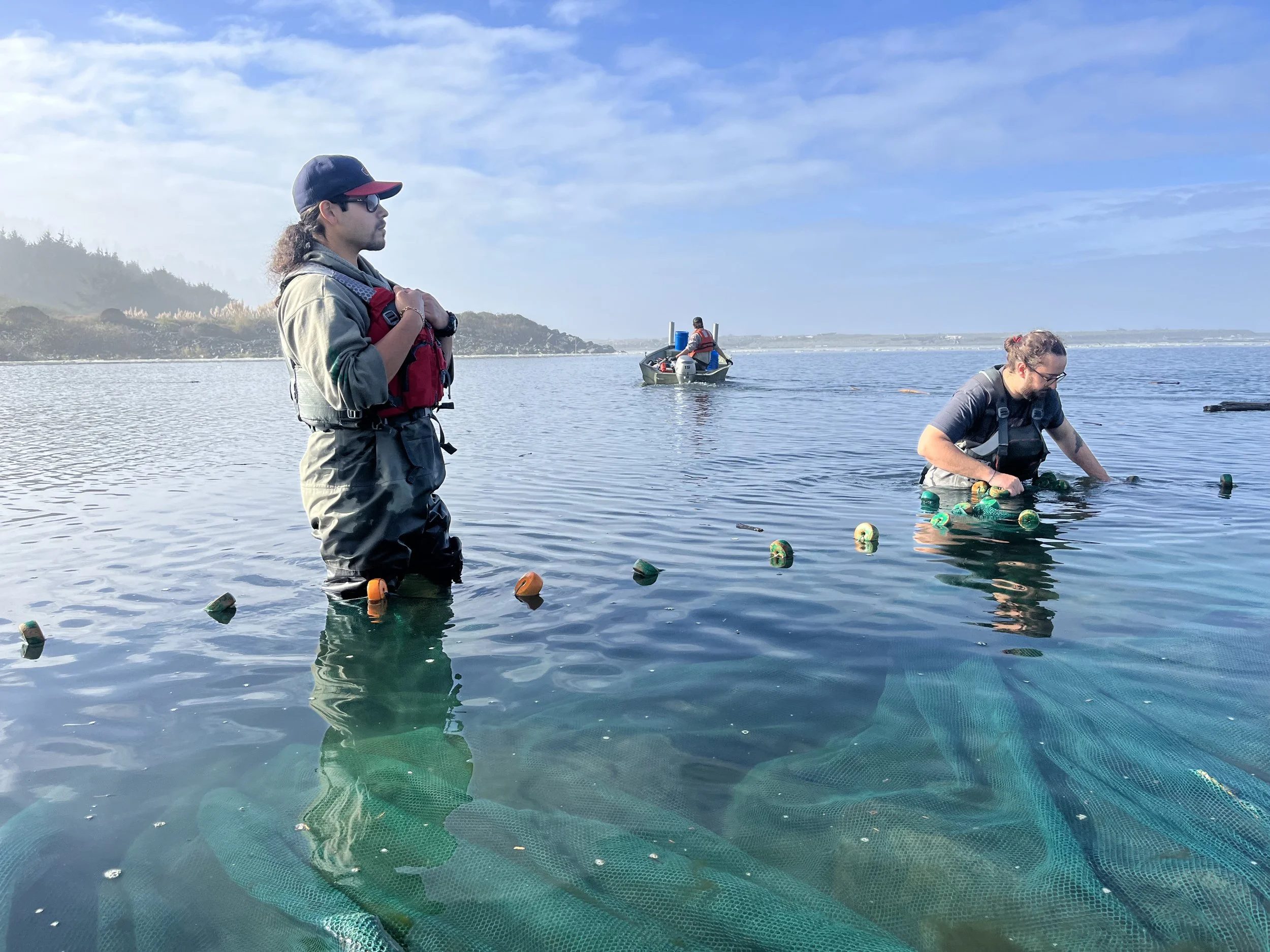
Pulikla Tribe of Yurok People conduct surveys with a seine net. Credit: TMSN
January 12, 2025
Along coastal ancestral lands and waters in California, six Tribal Nations are reclaiming their right to manage traditional territories. Walk along the wide-open beaches south of Crescent City, and you might see Tribal Stewards monitoring for harmful algae blooms that threaten mussels and other subsistence foods. Or hike along a creek in the coastal forest near Monterey, and you can see stewards supporting the return of salmon after recent dam removals.
These and countless other stewardship responsibilities are carried out by the Kashia Band of Pomo Indians, the Tolowa Dee-ni’ Nation, the Pulikla Tribe of Yurok People, the Amah Mutsun Tribal Band, the Santa Ynez Band of Chumash Indians, and the Trinidad Rancheria.
Inspired in part by Indigenous Guardians in Canada and Indigenous Rangers in Australia, four founding Tribal Nations formed the Tribal Marine Stewards Network (TMSN) to support each other as they reassert their inherent responsibility to care for lands and waters. Since launching the network in 2020, they have seen the benefits ripple outward, including adding two more Tribal Nations.
“The biggest part of this work is returning Tribal stewardship, but it’s not just monitoring. It’s uplifting the community voice and what they think is important,” said Megan Rocha, the executive director of the Pulikla Tribe of Yurok People, member of the TMSN Leadership Council, and Governor Appointee to the California Ocean Protection Council. “It’s also about cultural lifeways and providing tribal workforce development. It all underlines the concept of community healing and health and wellness.”
“My ancestors were scientists before the word scientist came into their lives. We have the understanding of what it takes to protect our coast and our ocean.” —Jaytuk Steinruck, Tribal Council for the Tolowa Dee-ni’ Nation
It also benefits California: Californians cherish these iconic coastal lands, and the state is working to protect 30% of lands and coastal waters by 2030 to sustain animals and plants, increase access to nature, and reduce climate risks. Indigenous-led conservation and stewardship makes it possible to achieve that goal.
“My ancestors were scientists before the word scientist came into their lives,” said Jaytuk Steinruck with the Tribal Council for the Tolowa Dee-ni’ Nation and member of the TMSN Leadership Council. “We have the understanding of what it takes to protect our coast and our ocean.” The Tribal Marine Stewards Network, he added, is helping bring “Native people to the forefront and supporting the Tribes of this state to continue to look after the resources that are so important to all of us.”
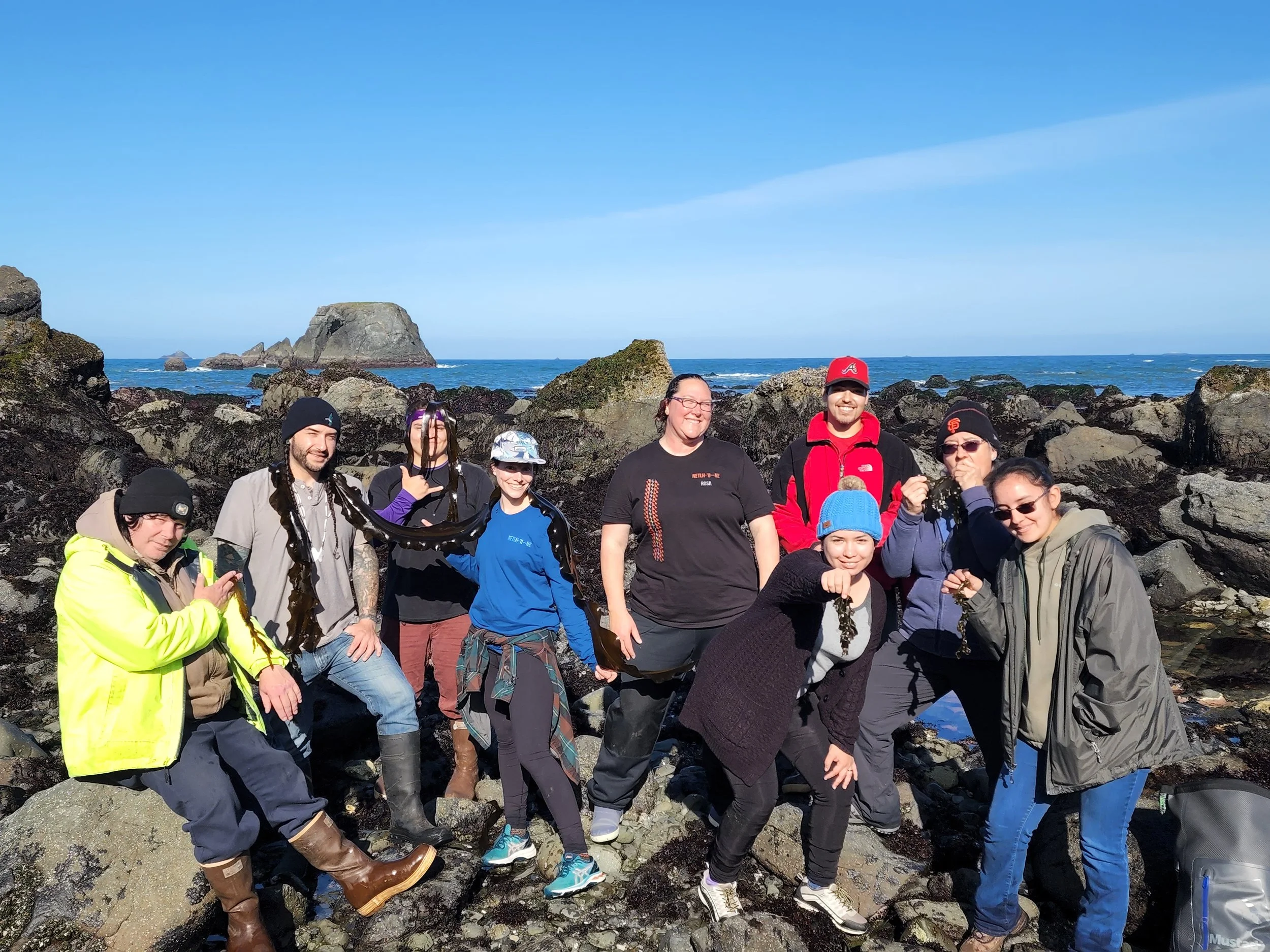
Staff from three TMSN member nations conduct a Tribal Intertidal Digital Ecological Survey (TIDES) near Smith River, California. “I see a huge sense of pride. I’ve seen young people have job opportunities they never would have had before,” said Megan Rocha. Credit: TMSN
The Road to Co-Management
Tribal Nations have been caring for lands and waters along the Pacific for millennia, yet their rights have rarely been acknowledged by settler communities and legal systems. None of the 18 treaties negotiated and signed by Tribes in the mid-1800s were ratified by the US Senate, so while there are now 109 federally recognized (and dozens of unrecognized) Tribes in California, those communities have managed to hold on to very few acres of land, and few state laws honor Tribal rights.
That includes newer laws as well. About a decade ago, California passed legislation to create a network of marine protected areas stretching from Oregon to Mexico. But the law did not consider the unceded rights of Tribal Nations, nor did it make provisions for nations to play a role in managing marine protected areas. Tribal Nations throughout the state came together to make their voices heard, and their advocacy led to several firsts for California:
Tribal citizens could fish in marine protected areas within their ancestral territories—the
first-ever recognition of these harvesting rights by the state.
Indigenous knowledge would help guide marine protection as a valid form of science—
the first time California recognized another body of technical knowledge.
The state also funded baseline monitoring projects which included some Tribal participation. But progress toward long-term, Tribally led stewardship stalled out and an underlying adversarial tone and exclusion persisted. So, several North Coast tribes helped convene a pivotal, two-day meeting with state leaders and a couple early supporting organizations.. The focus was deepening connections and partnership in achieving the common goal of marine protection within waters shared by the State and Tribal Nations. Soon after, the state committed to supporting stewardship programs for several Tribal Nations.
This planted the seeds of the Tribal Marine Stewards Network and in subsequent years, heightened discussions about co-governance and co-management agreements with the State of California. “To come to a place where we are collaborating and talking about co-management and the State is investing in these Tribal communities, it’s amazing and really hopeful,” said Megan Rocha.
Building a Network Rooted in Self-Determination
With support in place, Tribal representatives began expanding their stewardship capacity. They hired and trained staff, but they also took time to design the structure of the network. That included creating a strong core while also recognizing that Tribal governments are the ultimate authority. “It’s important in the network that each Tribe’s sovereignty is respected, and each Nation can move forward in their own self-determined way,” said Rocha.
Abreanna Gomes, the Senior Natural Resource Specialist with the Kashia Band of Pomo Indians and TMSN Leadership Councilmember, added that having “a coalition of Tribal Nations working together makes each tribe involved that much stronger.” At its heart, the network aims to create long-term stewardship that meets the needs of the Tribal communities, elevates their voices, and uplifts everyone together.
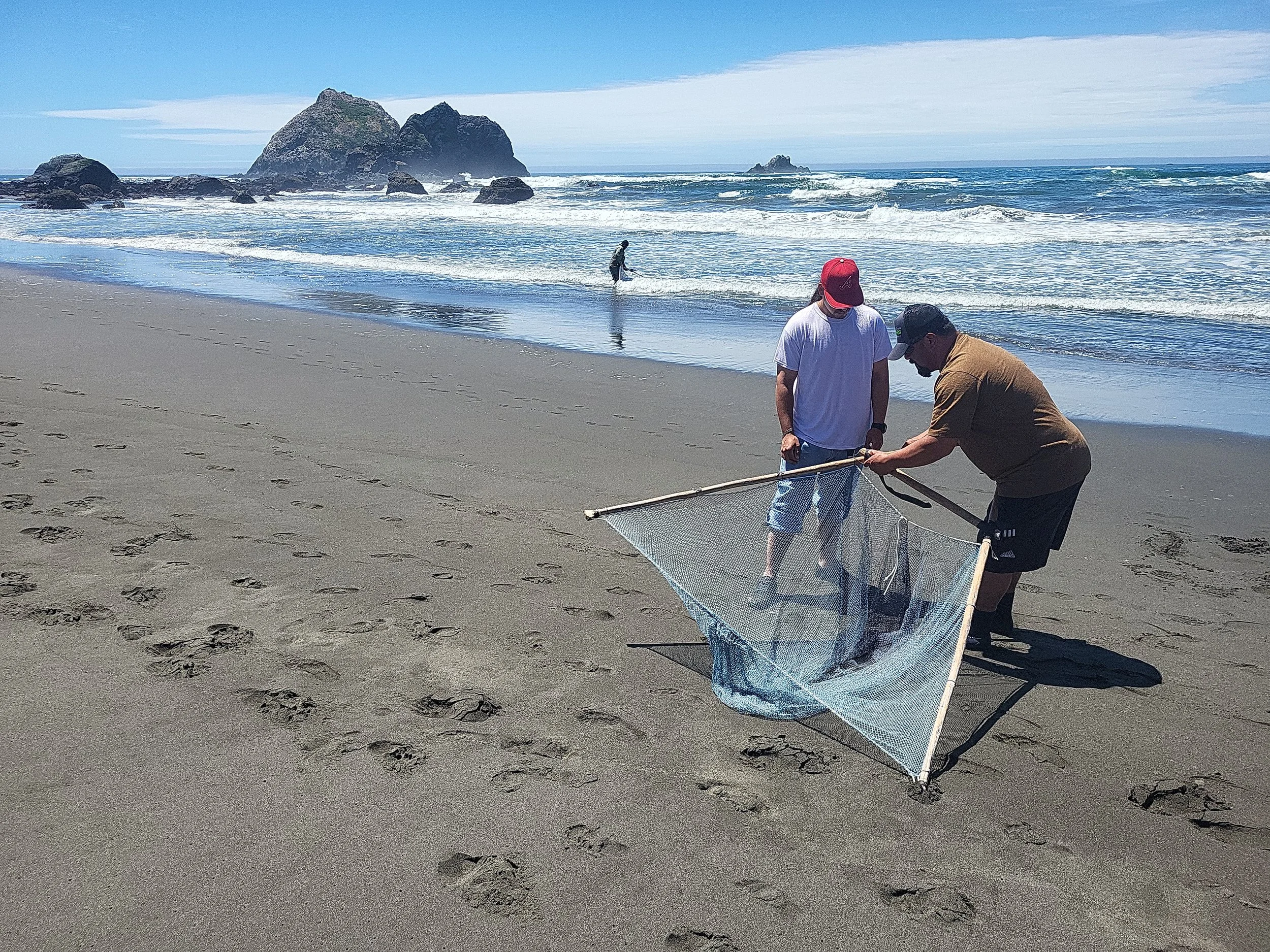
Jaytuk Steinruck of Tolowa Dee-ni’ Nation teaches Tylor Jones of Pulikla Tribe of Yurok People how to use a traditional fishing net to catch surf smelt. Credit: TMSN
Knowledge Exchanges Bring Inspiration and Friendship
Those early planning conversations drew inspiration from other Indigenous Nations. Several TMSN members traveled over 1,500 miles north to the winding inlets and steep fjords around Bella Coola, British Columbia, where they met and trained with Coastal Guardian Watchmen from the Nanwakolas Council. Guardian Watchmen care for marine waters, monitor fisheries, and serve as first responders in their territories. They are part of a larger Guardians movement in Canada, where federal investments helped enable more than 200 First Nations to launch Guardians programs, creating over 1,500 stewardship jobs.
At the Nanwakolas Council, the Watchmen brought their California visitors out on boats, showed them data collection tools, and talked about common concerns, like their role in enforcement and public outreach. “It was absolutely amazing to go there,” said Rocha. “Everyone was so kind and gracious. It helped us see what’s possible.”
The Watchmen explained that their work was partly inspired by Indigenous leadership in Australia, where nearly 130 Indigenous Ranger groups care for lands and where Indigenous Protected Areas account for more than half the country’s conserved lands. So, the TMSN secured a grant to travel to meet Land and Sea Rangers in Queensland, and once again, they were met with warmth and generosity.
“It was absolutely amazing to go [British Columbia]. It helped us see what’s possible.” —Meagan Rocha, Executive Director of the Pulikla Tribe of Yurok People
“What stood out was the way each program was tailored to the community,” said Rocha. “One group focused on wild hogs, another on turtles, and another on fire. It was driven by the community’s priorities.” Back home, they realized, the network could also put Nations’ priorities first. For instance, some communities want to monitor fish species that have cultural significance but may be ignored by the state because they are not part of a commercial fishery.
Both the Rangers and the Watchmen welcomed the TMSN visitors with openness. “They were like, ‘Oh, you are trying to figure this out, we’ll share what we do,’” said Rocha. “I appreciated that so much, and we want to have that same spirit when people are trying to figure it out here too.”
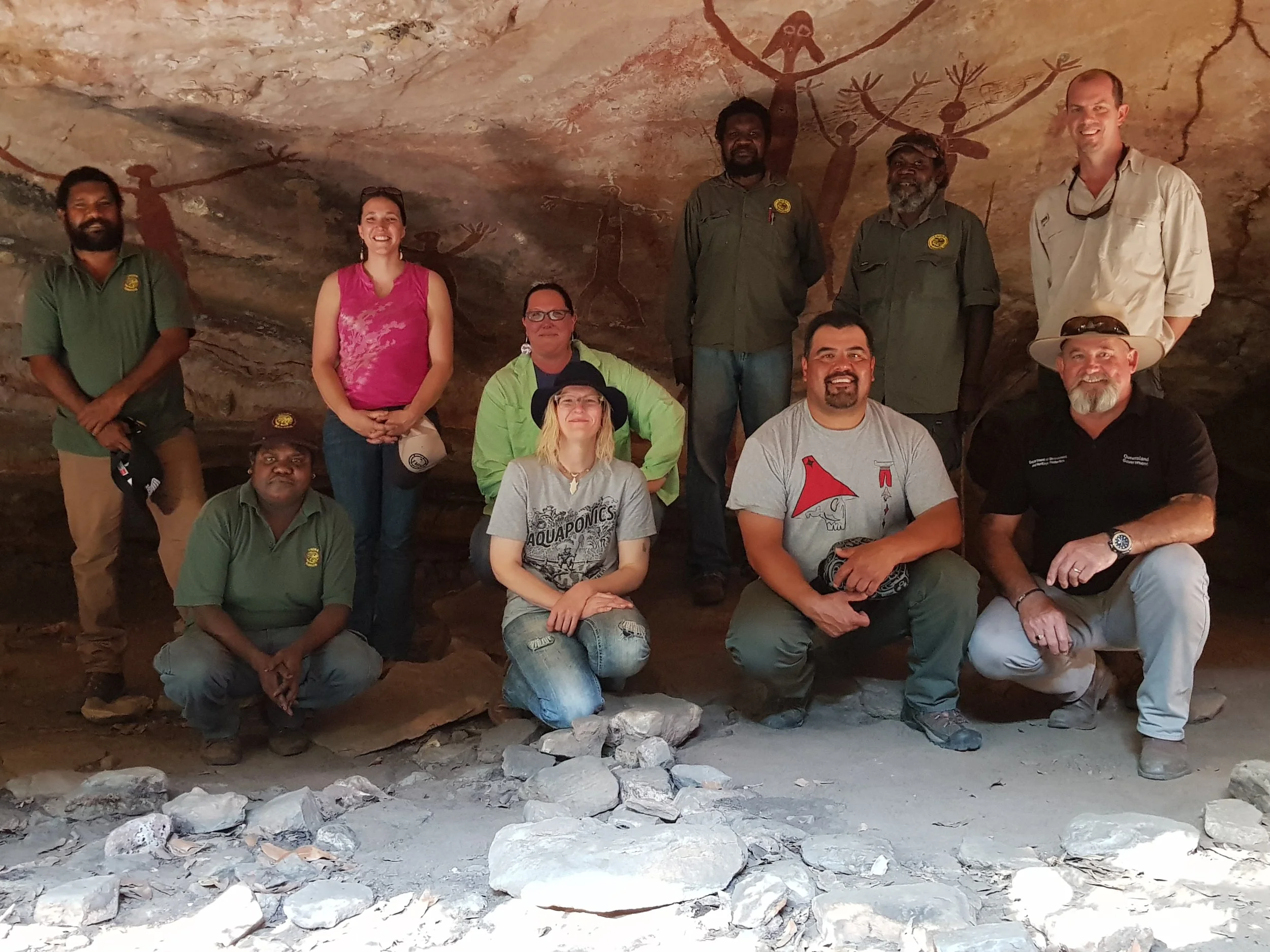
Members of the TMSN meet with Land and Sea Rangers in Queensland; nearly 130 Indigenous Ranger groups care for lands and waters in Australia. Credit: TMSN
A Day in the Life of a TMSN Steward
Now, after those early building years, TMSN programs are thriving. Every day, stewards undertake work that reflects the values, knowledge, and priorities of their Nations. In the Tolowa Deeni’ Nation, that includes sampling for biotoxins in dee-lhat (mussels) and met’e (razor clams) to make sure they are safe for human consumption. Rudy Lopez, a Tribal Resource Specialist with the Nation, said, “We test them every month, so if our Tribal citizens or Elders want to eat these any time, they can check our website for the Tribe and always know if they are safe to eat. It’s an important cultural food source for our people.”
In the Pulikla Tribe of Yurok People, south of Crescent City, stewards conduct habitat assessments and other studies of juvenile surf smelt, which have shown big declines. Stewards have also made traditional fish nets—a practice lost to some families—and hosted ocean camps where youth could eat the fish, some for the first time.
Farther south, in the heart of Monterey Bay, stewards with the Amah Mutsun Tribal Band conduct archaeological surveys at culturally significant sites, including one over 7,500 years old. Done in partnership with California State Parks and UC Berkeley, the work helps root today’s stewardship in traditional knowledge.
Meanwhile, all TMSN Nations collaborate on the Tribal Intertidal Digital Ecological Surveys (TIDES), a yearly mapping of the rocky intertribal zone. It tracks species abundance in the face of climate impacts like ocean acidification, and it will provide a 3D model illustrating all biota in the area.
Going forward, some TMSN stewards will play a role in a pathbreaking assertion of inherent sovereign responsibility: in 2023 three Tribal Nations announced the Yurok-Tolowa Dee-ni' Indigenous Marine Stewardship Area, the first-ever Tribally designated marine protected area in the United States.

Water quality testing is a core part of coastal stewardship; for TMSN that monitoring is placed in the context of the Nations’ own priorities, values, and voices. Credit: TMSN
Transformative Benefits for People and the Land
These stewardship projects help restore the land and sea, but that’s not all. They also generate wide-ranging benefits for people and communities. In a region hit hard by waves of boom-and-bust cycles from gold mining to fishing to logging—TMSN points to a more restorative economy.
“I see a huge sense of pride. I have seen young people have job opportunities they never would have had before, jobs that uplift the knowledge of their families,” said Rocha. “I have seen people have greater stability, potentially get a home, stay away from substance issues.” Stewardship and economic development also strengthen Tribal self governance, weaving through the declaration of the Indigenous Marine Protected Area and the co-sponsorship of bills in the legislature. And they bolster the relationship with the State of California.
“I see a huge sense of pride. I have seen young people have job opportunities that uplift the knowledge of their families.'“ —Meagan Rocha, Executive Director of the Pulikla Tribe of Yurok People
“There’s a continued shift in collaboration with the state,” said Rocha. “The vision is cogovernance, where the Tribe is governing ancestral lands and its people according to traditional law woven into their government and doing it in a collaborative way. Real sovereign-to-sovereign respect.”
The results flowing from TMSN echo similar work in Australia and Canada, where research shows each $1 invested in Indigenous-led stewardship programs can generate about $3 in social, economic, and cultural impacts. Forthcoming analysis from Canada shows the current return on investment runs between $5 and $12 for each $1 spent, and as high as $24 in some areas.
Beyond the dollar amounts and job figures, TMSN’s stewardship is about healing—healing for the community, the land, and the sea. “The coast is our home. It’s a way of life. We’ve been here for years and years, generations upon generations,” said Tylor Jones, Natural Resource Coordinator, Pulikla Tribe of Yurok People. “We’re in a very serious time of global impacts. Having that traditional knowledge brings back balance into the world.”
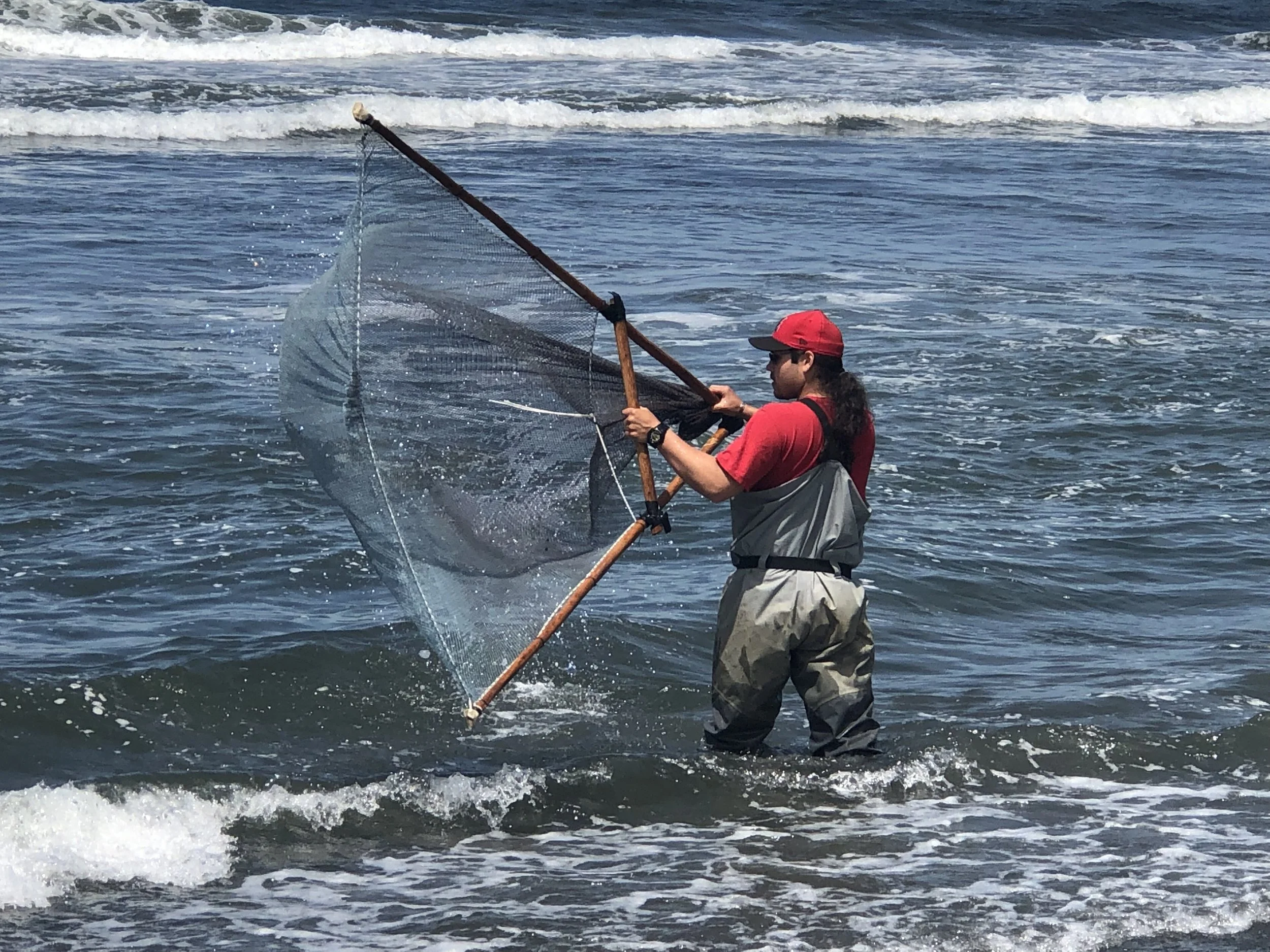
Tylor Jones of Pulikla Tribe of Yurok People uses a traditional fish net to catch surf smelt. Credit: TMSN